Hair Wound Into a Tub Drain
Hair and soap knot together just past a tub or shower trap. A small drum cable with a grabbing head winds the mat up and pulls it back out of the drain.
Now showing . Phone number, services and service areas are updated to your local crew. Phone, services & service area updated
Find your local crew
Pick a branch and we’ll show the right phone number, services and service area across the whole site. You can change it anytime from the top bar.
Phone, services and service area update to match.
OUR SERVICES
Drain snaking for Pleasant Hill homes and shops: hand augers on sinks and tubs, closet augers on toilets, sectional machines on mains, each with a head chosen for the clog.
OVERVIEW
A drain auger is a coiled steel cable, turned by hand or by motor, that travels through a drain to break up, cut through or hook a blockage. It works best on hair, wipes, toilet paper, soft stoppages, dropped objects and roots growing into a sound pipe. We at Clog Busters bring that tool to Pleasant Hill homes and storefronts from our Vandalia Road branch in Des Moines, which never closes.
Pipe size decides cable size. Chapter 158 of the Pleasant Hill Code of Ordinances amends the plumbing code so the main building drain must be at least 4 inches in diameter, which is why a Pleasant Hill main takes a heavier sectional cable than the small branch lines feeding it. The same chapter counts significant cracks, out of alignment pipe and missing pieces of pipe or fittings as compromised piping. That is where a cable stops being the answer, and a camera shows what comes next.
Our drain auger service page explains the equipment in more depth. Grease coating a line calls for hydro jetting in Pleasant Hill, and our Pleasant Hill service area page lists the rest.
Iowa's 2024 Uniform Plumbing Code, effective statewide March 26, 2025, governs our cable work in Pleasant Hill and any repair it leads to.
WHAT A CABLE CLEARS
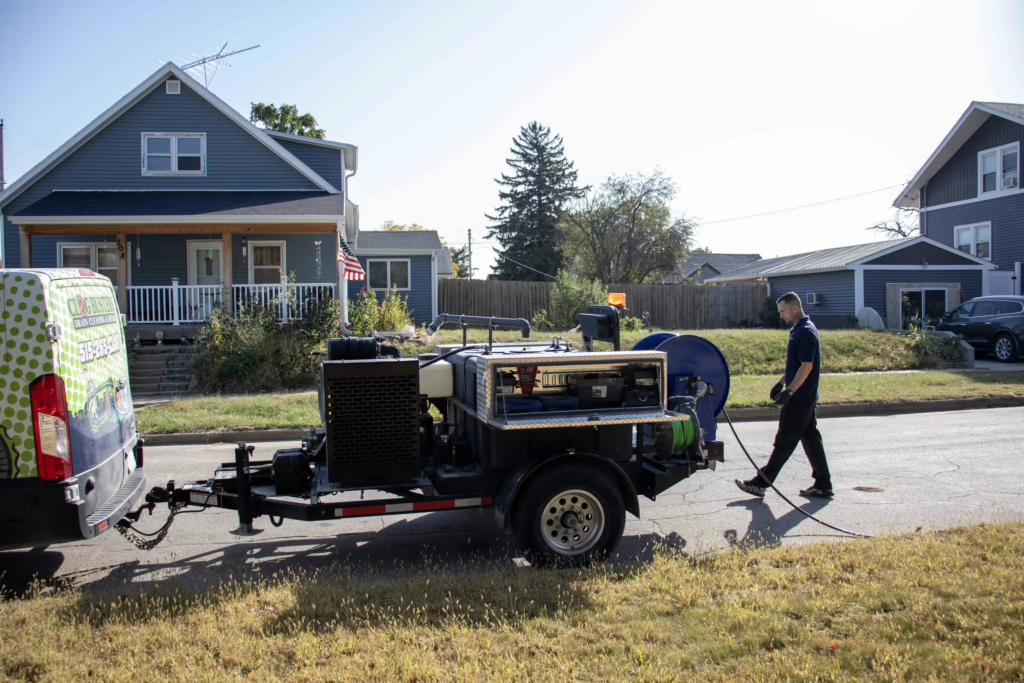
A cable wins on anything it can grab, cut or push through.
Hair and soap knot together just past a tub or shower trap. A small drum cable with a grabbing head winds the mat up and pulls it back out of the drain.
Wipes stay intact in water and snag where the line changes direction. A sectional cable with a cutting blade shreds the wad so the main flows again.
Too much toilet paper at once packs into the trapway. A closet auger, its cable inside a protective sleeve, clears it without scratching the bowl.
A toothbrush, a toy or a bottle cap rarely flushes away for good. A retrieval head can often hook it and bring it back instead of pushing it deeper.
Fine roots growing through a joint can be cut back with a root saw head. If the pipe around that joint is intact, cutting restores full flow.
A basement floor drain that will not empty often has silt or debris in its trap. A medium cable clears it, and we check whether the main is the real cause.
CABLE SIZES AND HEADS
Cable matched to the pipe, from a bathroom sink to the main.
Small diameter drains get a thin hand or drum cable that bends through the trap without stressing older fittings.
A medium cable opens a kitchen line plugged with food scraps. When the camera shows grease lining the pipe, we recommend jetting rather than cabling it twice.
Drum machines reach past the trap into the branch where hair collects, often entering through the overflow so the drain body stays untouched.
A closet auger works through the bowl. If the clog sits past the toilet, we pull it, reach the line from the flange, and reset it on a new wax ring.
Washer lint and floor drain silt call for a medium cable and a head that scrapes the pipe wall instead of poking one small hole.
The main gets a sectional machine with heavier cable, fed through a cleanout so the cable meets the blockage on a straight path.
WHY CLOG BUSTERS
Reach the clog the easy way, choose the cable, open the pipe, then prove it.
A cleanout is the best entry for a main line. For a fixture, we use the trap, overflow or toilet flange, whichever gives the straightest path.
Cable diameter follows pipe size. The head follows the blockage: a grabbing head for hair, a cutting blade for wipes and paper, a root saw for roots, a retrieval head for objects.
We feed slowly and let the head do the work, backing off when the cable loads up so it cannot kink or knot inside the pipe.
We run water at volume. On a main line, a camera pass shows whether the pipe is open and sound, or whether cracks, offsets or missing pipe call for a repair plan.
We wipe the cable down as it comes out, clean the work area, and tell you what caused the clog and how to keep it from coming back.
FAQ
Still stuck? Call the Des Moines shop at (515) 259-1991.
A drain auger is a flexible steel cable that spins as it travels through a drain, with a head on the end that grabs, cuts or hooks a blockage. Hand augers handle sink traps, drum machines handle tub, laundry and kitchen branches, and sectional machines drive heavier cable through a main line. People also call it a drain snake or a cable machine. In Pleasant Hill homes we choose the size by the pipe it has to travel.
Skip the auger when the problem is a coating or a broken pipe rather than a blockage. Grease, sludge and scale line the pipe wall, and a cable only bores a path through them, so the clog returns. If the pipe itself is cracked, shifted at a joint or caved in, spinning steel can catch the broken edge, so that line needs a repair instead. A camera run tells us which case applies before we recommend jetting or a repair.
Pleasant Hill's plumbing code amendments describe compromised piping as pipe with significant cracks, pipe out of alignment, or missing pieces of pipe or fittings, as determined by the code official. The same amendments say that if any part of an Orangeburg building sewer fails, the whole Orangeburg line must be replaced from the building to the public sewer. Orangeburg is a bituminous fiber pipe that softens and deforms with age. If our camera finds it in a Pleasant Hill line, we tell you before any cable goes through it.
A main line needs a bigger cable because it is a larger pipe carrying waste from every fixture. Pleasant Hill's code amendments set a 4 inch minimum diameter for the main building drain. A thin sink cable can coil up in a pipe that size and miss the blockage, while a sectional cable stays stiff enough to reach it and cut it.
A rented hand snake is fine for a sink or tub trap. On a toilet or a main line, an unsleeved cable can scratch porcelain, and a powered cable that knots inside a main can be harder to remove than the clog itself. If a first try fails, stop rather than force it.
A cable machine does not scratch or crack sound pipe when the cable is sized to the line and run with control. Damage comes from too heavy a cable in a small drain, or from forcing a cable through pipe that is already broken. If a camera shows a break, we stop cabling and explain the repair options.
Most repeat clogs stop when what goes into the drain changes. Keep wipes out of the toilet even when the package says flushable, set a strainer over tub and shower drains, and scrape plates into the trash before rinsing. If the same drain clogs again within weeks, a camera inspection usually finds a sag, an offset joint or roots behind it.
A cleanout is the best way into a main line, but not the only way. Without one, we can reach the line by pulling a toilet or through a basement floor drain, though those routes give the cable a tighter path. If your home has none, adding one makes every future cable or camera visit easier.
Local coverage