Hair Wound Into a Tub Drain
A small drum machine with a grabbing head twists the hair into a rope and draws it back up the drain, rather than packing it deeper into the branch.
Now showing . Phone number, services and service areas are updated to your local crew. Phone, services & service area updated
Find your local crew
Pick a branch and we’ll show the right phone number, services and service area across the whole site. You can change it anytime from the top bar.
Phone, services and service area update to match.
DRAIN AUGER SERVICE
Cable machine clearing for North Liberty sinks, tubs, toilets, floor drains and main sewers, with the cable sized to the pipe, from our Herky Street branch 24 hours a day.
THE CABLE METHOD
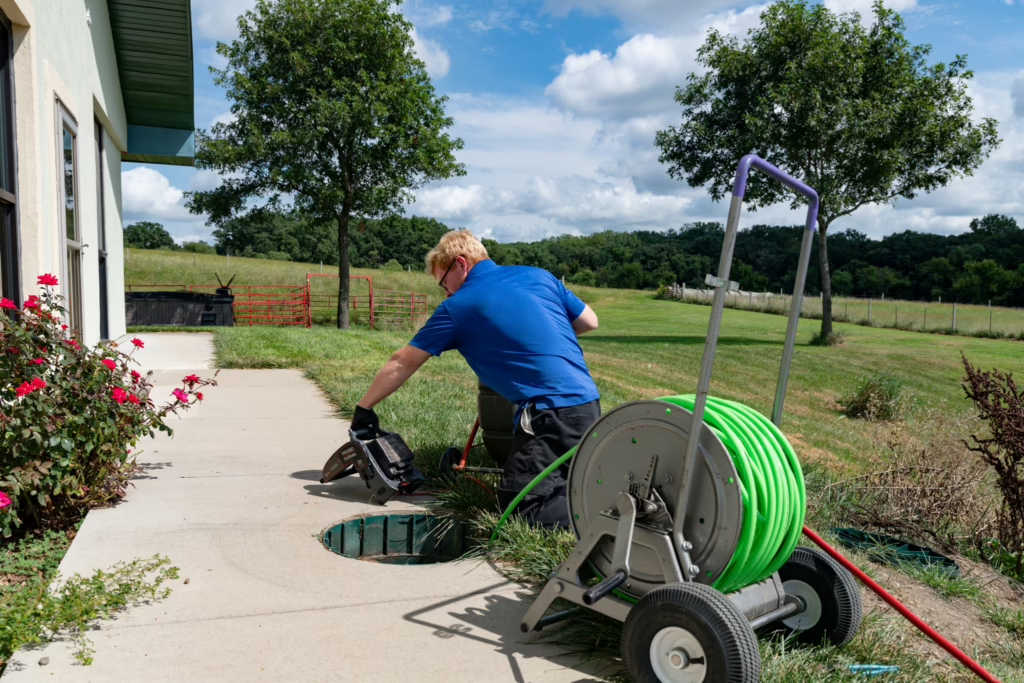
A drain auger is a motor-driven steel cable fed into a drain until the head on its tip reaches the blockage, then cuts through it, grabs it or hooks it and pulls it back out. It is also called a drain snake or cable machine. We at Clog Busters run augers on sinks, tubs, toilets, floor drains and main building sewers from our North Liberty branch at 390 Herky Street, Suite 1E.
Section 719 of the 2024 Uniform Plumbing Code, which Iowa put into effect on March 26, 2025, places the building sewer cleanout either inside, near the point where the building drain becomes the sewer, or outside at the end of the building drain, brought up to grade. The same section spaces added cleanouts no more than 100 feet apart on straight runs and adds one wherever horizontal turns add up to more than 135 degrees, and it requires each one to open in the direction of flow. That is the straight, downstream entry a main line cable is designed for.
When grease coats the pipe wall rather than plugging it, hydro jetting in North Liberty is the better tool. See also our drain auger service.
Cleanout access and any repair after cabling meet the Iowa-adopted 2024 Uniform Plumbing Code.
WHAT A CABLE CLEARS
A cable is the right first tool when something is stuck inside pipe that is still in good shape.
A small drum machine with a grabbing head twists the hair into a rope and draws it back up the drain, rather than packing it deeper into the branch.
Wipes do not fall apart the way toilet paper does. A main line cable with a cutting blade shreds the wad so the next flush can carry it away.
Too much paper at once can lodge in the trapway or just beyond the flange. A closet auger with a guarded tube reaches it without scuffing the bowl.
Soft buildup at the trap arm or the tee behind the wall opens with a light cable.
A retrieval head can snag a solid object and bring it back, instead of driving it downstream where it would catch everything flushed after it.
A root cutting head shears growth that has slipped in at a joint, provided the pipe itself is intact. Cracked pipe needs a repair, not more cutting.
CABLES MATCHED TO THE LINE
A bathroom sink and a building sewer need very different cables.
A thin, flexible cable that turns through the trap and trap arm, fed from the trap opening so it never has to force a tight bend.
A compact drum machine for small branch lines, fitted with a head that grabs hair rather than chopping it into pieces that settle farther along.
A closet auger through the trapway first. If the blockage sits past the flange, we pull the toilet and cable the line from the floor.
A mid-size cable through the drain or a nearby cleanout for lint, hair and debris washed down from laundry, utility sinks and garage floors.
A heavy machine through the main cleanout, with a blade sized close to the pipe so the cable opens the full bore, not a narrow tunnel.
We can often enter through a pulled toilet or a roof vent, and we tell you whether adding a cleanout would make the next visit simpler.
WHY CLOG BUSTERS
Choose the entry, size the cable, open the line, and confirm it drains under load.
We ask which fixtures are slow or backing up. One fixture points to its branch; several at once usually means the building drain or sewer.
A cleanout gives the cable a straight entry in the direction of flow. Without one, we work through the fixture, a pulled toilet or a vent.
Cable thickness follows the pipe size. The head follows the blockage: a grabber for hair, a blade for wipes and paper, a cutter for roots.
We run the cable through and back several times. Whatever returns on the head, whether hair, wipes, roots or pipe fragments, tells us why the line blocked.
Water at full volume confirms the line carries a load. A main that keeps closing or gives up pieces of pipe gets a camera before any other recommendation.
FAQ
Still stuck? Call the North Liberty shop at (319) 209-6817.
A drain auger is a rotating steel cable that cuts, grabs or retrieves a blockage, while hydro jetting uses pressurized water to scour the pipe wall. The cable is the better first tool for hair, wipes, paper, lost objects and roots in a sound line. Jetting fits a pipe whose walls are coated with grease or sludge, because a cable only opens a hole through that layer. Our North Liberty branch carries both.
A cable machine is safe for sound pipe when the cable fits the line, and it can do harm when the cable is the wrong size or is forced through a bend. We size the cable to the pipe and choose a head that fits the blockage. If the cable returns pieces of pipe or hangs up at the same spot, we stop and camera the line.
The main cleanout is usually a capped fitting where the building drain leaves the house, on the basement wall or floor near the foundation, or a capped pipe stub in the yard. Iowa's 2024 Uniform Plumbing Code, in force since March 26, 2025, allows the building sewer cleanout inside near that connection or outside at the end of the building drain, extended to grade. A cleanout under a driveway or patio has to stay reachable through a yard box or a fitting set flush with the paving.
A missing or buried cleanout makes main line cabling harder but rarely impossible. We can usually work through a pulled toilet or a roof vent instead. Those routes are longer and tighter, so a cleanout is still the better access. If the line needs regular service, we can talk about adding one.
An auger clears the blockage but cannot change what caused it. When the same line closes again within weeks or months, something in the pipe is catching waste, such as a low spot, an offset joint or roots at a crack. Putting a camera through the line once it is open tells us which of those we are dealing with.
A small hand auger is fine for a single sink or tub clog. Main lines are a different job: a rental machine with the wrong cable can kink, whip or get stuck in the pipe, and it cannot tell you why the line blocked. If more than one fixture backs up, or water rises from a basement floor drain, call before running a machine.
Yes, wipes are among the most common things a main line cable brings back. Even wipes sold as flushable hold together in water instead of breaking down like toilet paper, so they snag on joints and roots. Once a few hang up, paper and waste pile in behind them. Putting wipes in the trash is the simplest way to avoid a repeat visit.
No, skip the chemical drain opener once you have decided to call. Caustic or acid cleaners rarely dissolve wipes, objects or roots, so the water stays put with the chemical sitting in it. That liquid can splash when a trap is opened or a cable spins in the line. If you already used one, tell the technician which product it was before any work starts.
Local coverage