Hair Knotted in a Tub or Lavatory
Hair and soap knot together at the trap and the first fitting below it. A small drum machine with a grabbing head pulls the mat out in one piece.
Now showing . Phone number, services and service areas are updated to your local crew. Phone, services & service area updated
Find your local crew
Pick a branch and we’ll show the right phone number, services and service area across the whole site. You can change it anytime from the top bar.
Phone, services and service area update to match.
CABLE DRAIN CLEANING
Cable machine work for Oskaloosa sinks, tubs, toilets, floor drains and main lines, sized to each pipe and sent from our 212 North C Street branch around the clock.
OVERVIEW
A drain auger is a motor-driven steel cable that spins a cutting or retrieving head through a pipe to break up or pull out whatever is blocking it. We at Clog Busters run cable machines on kitchen, bath, laundry, floor drain and main lines for homes and businesses in Oskaloosa, Beacon, Eddyville, Evans, Lacey, Leighton, University Park and Keomah Village from our branch at 212 North C Street, open 24 hours a day.
A cable works best on the very things the city keeps out of its sewers. Section 13.08.380 of the Oskaloosa Municipal Code prohibits solid or viscous material in amounts that can block flow, naming rags, hair, plastics, sand, and paper cups and dishes, whether whole or ground up in a garbage disposal. Those same materials usually snag on a trap or a joint inside the house first, and a spinning head is built to grab them.
Grease coating a pipe wall, or a pipe that has cracked or sagged, is a different job. When the camera shows that, we point you to hydro jetting in Oskaloosa or a repair instead of running the cable again. See our drain auger service, the Oskaloosa branch page, or drain cleaning in Oskaloosa for every clearing method we use.
Cable work and the drain lines it reaches are handled under the 2024 Uniform Plumbing Code, which Iowa put in force statewide on March 26, 2025.
WHEN A CABLE FITS
A cable is the right first tool when something is lodged in the pipe rather than coating its walls.
Hair and soap knot together at the trap and the first fitting below it. A small drum machine with a grabbing head pulls the mat out in one piece.
Wipes sold as flushable hold together like cloth and catch where the closet bend turns. A closet auger reaches through the bowl and hooks them free.
A heavy wad of toilet paper can still plug a bend. The cable breaks it into pieces the next flush carries away.
A retrieval head is built to snag an object and bring it back instead of wedging it farther down the line.
Peels, rice and coffee grounds settle where a sink line runs nearly flat. The cable opens a path, and a camera shows whether grease is holding the pile together.
A cutting head shears root growth back to the pipe wall. It restores flow, but only a repair keeps roots out of that joint for good.
CABLE SIZES AND ACCESS
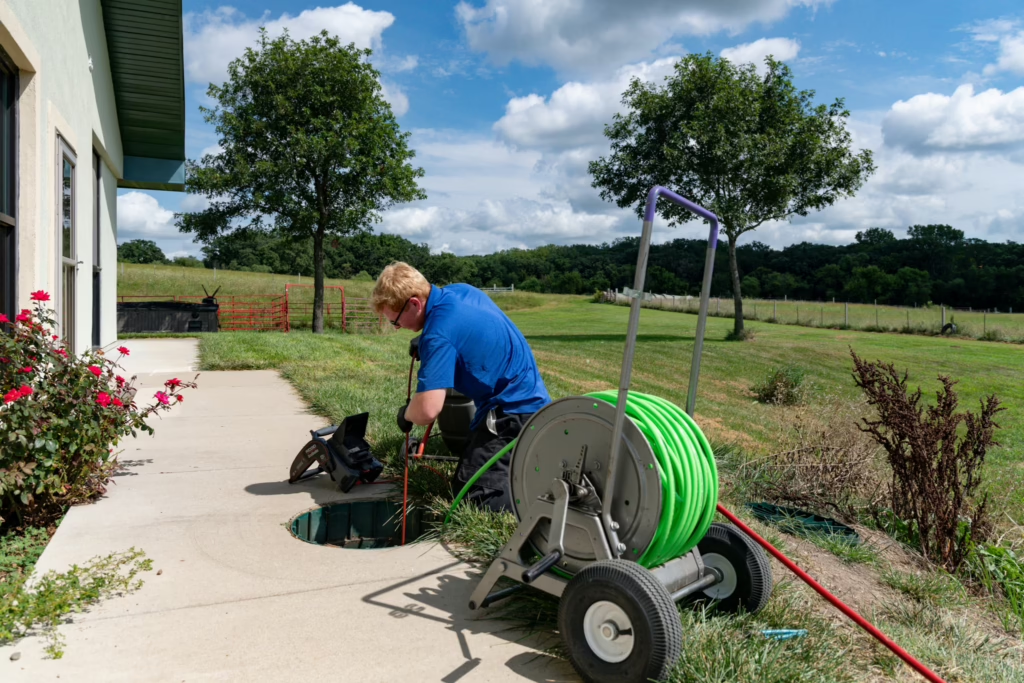
Cable diameter, head and access point change with every fixture. One machine for everything is how pipes and porcelain get damaged.
A light, flexible cable fed through the trap or the tailpiece, so it turns the tight bends of a small drain without scraping the fixture.
A drum machine works through the overflow or the drain opening and keeps hair wound on the head instead of pushing it toward the stack.
A closet auger carries a guarded tip through the trapway so bare steel never touches the glazed porcelain. If the clog sits past the bend, we pull the toilet and go in from the flange.
Oskaloosa code calls for the building sewer to enter below the basement floor where possible, so the floor drain is often the most direct path toward the main for a heavier cable.
A sectional machine with a heavier cable and cutting blades works the building sewer from a cleanout toward the city main, where roots and packed paper usually sit.
Where a basement drain sits too low to flow by gravity, Oskaloosa code requires the sewage to be lifted to the building sewer. We cable the line on either side of the pump, never through it.
WHY CLOG BUSTERS
Pick the access, size the cable, clear the pipe, then confirm it stays clear.
We trace which fixtures are slow and choose the entry nearest the blockage: a trap, an overflow, a floor drain, a cleanout or a pulled toilet.
Cable diameter follows pipe size, and the head follows the clog: a grabbing head for hair, a retrieval head for objects, blades for roots and packed paper.
We feed the cable slowly, work the blockage until the head turns freely, and pull the debris back out instead of shoving it farther down the line.
Filling and draining several fixtures together shows whether the line carries a full load or is still restricted downstream.
For main lines and repeat clogs, a camera shows whether the pipe is sound or needs jetting or repair, and you see the footage before any repair price.
FAQ
Still stuck? Call the Oskaloosa shop at (641) 200-0136.
Yes, they are the same tool under two names. Both are a coiled steel cable spun through a pipe to cut, break up or hook a blockage. A hand snake handles a sink trap, while a motor-driven cable machine reaches a main line. In Oskaloosa homes we size the cable to the drain it has to reach.
Oskaloosa Municipal Code Section 13.08.380 bans solid or viscous material that can obstruct sewer flow, listing rags, hair, plastics, sand, and paper cups and dishes, even when ground in a garbage disposal. Section 13.08.020 defines properly shredded garbage as particles no larger than half an inch. Keeping them out protects your own pipes, where most clogs start.
We do not recommend flushing them. Wipes are made to hold together when wet, so they tend to catch at a toilet bend, a rough joint or a root and collect paper behind them. Inside a pipe they act much like the rags the city code bans from the sewer. Put wipes in the trash and flush only toilet paper.
Yes, when the pipe around them is still sound. A cutting head shears roots back to the pipe wall and restores flow. It does not seal the joint the roots came through, so they grow back over time. If roots return quickly, a camera run shows whether that joint needs a repair.
A cable is the wrong tool when the problem is on the pipe wall or in the pipe itself. Grease and heavy buildup need scouring, which is a hydro jetting job, and a cracked, offset or collapsed section needs repair. A camera inspection settles which case you have before we go further.
We use the next best opening. That can be a basement floor drain, a sink trap, a tub overflow or the toilet flange after the toilet is pulled. Because Oskaloosa code has the building sewer enter below the basement floor where possible, a floor drain often gives a direct route toward the main. A cleanout near the foundation makes future cable work easier.
Often, yes. A retrieval head is designed to snag rings, toys, combs and caps and pull them back out. For a toilet, pulling the fixture and reaching in from the flange gives the best chance. Plunging first can push the object deeper, so leave the drain alone.
Keep the materials that cause clogs out of the pipe. Use a hair strainer in tubs and showers, scrape plates into the trash instead of the disposal, and flush only toilet paper. If a line still clogs soon after it was cabled, have it inspected with a camera, because a sag, a rough joint or roots are catching debris.
Local coverage