Showers Turning Cold Sooner
Shrinking hot water usually traces to sediment insulating the burner, a burned out lower element or a broken dip tube. Iowa's colder winter supply water makes a weak heater show it first in January.
Now showing . Phone number, services and service areas are updated to your local crew. Phone, services & service area updated
Find your local crew
Pick a branch and we’ll show the right phone number, services and service area across the whole site. You can change it anytime from the top bar.
Phone, services and service area update to match.
WATER HEATER SERVICE
Gas, electric and tankless water heaters diagnosed, repaired or replaced in Johnston, with the pan drain, shutoff, venting and relief piping set up the way the city's plumbing code asks.
OVERVIEW
Water heater repair and replacement means finding out why a tank or tankless unit stopped making hot water, fixing the failed part when the heater is still sound, and installing a new one when it is not. We at Clog Busters do both for Johnston homes and businesses from our Des Moines branch at 3950 Vandalia Rd, open 24 hours a day, 7 days a week.
Johnston adds a few rules of its own on top of the state code. The city’s plumbing code amendments in Section 156.04 of the Johnston City Code call for a Schedule 40 PVC drain from a water heater pan to be at least 1 inch, and for shutoff and control valves to be readily accessible. Both come up in finished lower levels, where a heater closed into a utility closet can end up with its cold supply valve behind a shelf and a pan drain sized to the old minimum.
Our water heater services page covers the work in general. A tank emptying onto the floor at 2 a.m. belongs with emergency plumbing in Johnston, and everything else we handle in town is on our Johnston page.
Water heater installations in Johnston follow the 2024 Uniform Plumbing Code, enforced across Iowa since March 26, 2025, together with the local amendments in Chapter 156 of the Johnston City Code.
WARNING SIGNS
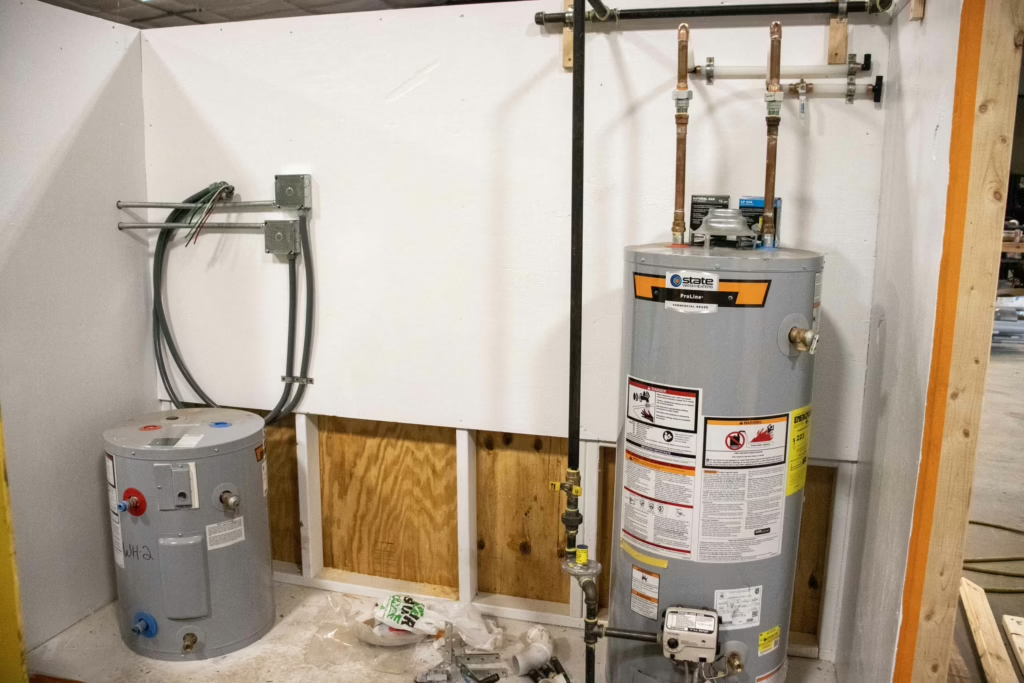
Most heaters warn you weeks before the floor gets wet.
Shrinking hot water usually traces to sediment insulating the burner, a burned out lower element or a broken dip tube. Iowa's colder winter supply water makes a weak heater show it first in January.
Water trapped beneath a sediment layer flashes to steam as the burner fires. The noise means the tank bottom is overheating and the heater is losing efficiency.
A worn thermocouple or flame sensor, a dirty burner or a blocked air intake will shut a gas heater down. So will unsteady gas pressure at the meter.
When cold runs clear and hot runs brown, the anode rod is used up and the steel tank has started corroding from the inside.
The temperature and pressure relief valve opens when the tank runs too hot or pressure climbs. Repeated dripping points to thermal expansion or a bad thermostat. Never cap it.
A leaking drain valve or fitting can be repaired. Water coming through the tank body cannot, and a pan only helps if its drain carries the water somewhere safe.
WATER HEATER SERVICES
Tank and tankless, gas and electric, for homes and businesses.
Thermocouples, flame sensors, igniters, gas control valves and burners, plus a draft test so exhaust leaves through the vent instead of spilling into the room.
Upper and lower elements, thermostats and the high limit switch, each tested with a meter so we replace the part that failed and not the one next to it.
The old tank drained and removed, the new one set in a pan where the location calls for one, then connected, filled, fired and checked for leaks.
Descaling heat exchangers and cleaning inlet screens on existing units. For a new install, we confirm gas line capacity and a workable vent route first.
Expansion tanks charged to match house pressure, and relief discharge lines run full size to a visible, safe termination.
Draining sediment before it hardens and replacing a spent anode keep a sound tank in service longer.
WHY CLOG BUSTERS
Test the parts, lay out both options, install it right, then prove it works.
Elements and thermostats get a meter, gas heaters get a flame and draft check, and we look at the relief valve, anode, vent and expansion tank before naming a cause.
You hear what the repair fixes, what condition the rest of the tank is in, and what a replacement would involve, then you choose.
Fuel type, first hour rating, vent route, combustion air, pan and expansion tank are settled up front, along with whether the job needs a Johnston permit and inspection.
The old tank is drained and taken out. The new one gets its gas or electrical connection, water lines with a reachable shutoff, relief discharge piping and a pan drain where required.
We check every gas and water joint for leaks, confirm the vent drafts, verify outlet temperature and expansion tank charge, then haul the old heater away.
FAQ
Still stuck? Call the Des Moines shop at (515) 259-1991.
Plan on one. Johnston enforces the Uniform Plumbing Code as adopted by Iowa, and replacing a water heater is installation work rather than one of the minor tasks that code exempts from permits. Confirm the details for your address with the Johnston Building Department, and ask any contractor you hire who will hold the permit.
Repair it when one part has failed and the tank itself is sound. Elements, thermostats, thermocouples, gas valves and relief valves are all replaceable. Replace it when the tank body leaks, the hot water runs rusty from internal corrosion, or sediment has damaged the bottom of the tank. We show you the condition of the tank so the decision is yours.
The right size comes from your busiest hour of hot water use, not the square footage of the house. A tank's first hour rating tells you how much hot water it can deliver in that hour. Two showers running while the dishwasher fills needs more than a household that spreads its use out. Colder winter supply water also slows recovery.
Often, but the house has to support it. A gas tankless unit draws far more gas at full fire than a tank heater, so the gas line and meter must carry that load. It also needs its own vent route, usually through a side wall.
Unsteady gas pressure is one common cause. The City of Johnston advises keeping the gas meter clear of snow and ice, because blocked vents on the meter can cause erratic pressure that keeps a furnace or water heater from working properly. Clear the meter carefully and see whether the pilot stays lit. If it still drops out, the thermocouple, flame sensor or gas control valve may need service.
It does when the heater sits where a leak would cause damage, such as above a finished room or in a finished space. The Uniform Plumbing Code calls for a watertight pan with a drain to an approved location in those cases. Johnston amends that section so a Schedule 40 PVC pan drain must be 1 inch or larger. A pan with no working drain only delays the water damage.
A dripping relief valve usually means pressure in the tank is climbing as the water heats. When a check valve, backflow device or pressure reducing valve keeps that expanded water from moving back toward the street, the plumbing becomes a closed system and needs a thermal expansion tank. A weak valve or a thermostat running too hot can cause it as well. Never cap or plug the valve.
Either symptom points to the heater rather than the water supply. Rusty hot water means the anode rod is used up and the tank is corroding. A sulfur smell usually comes from a reaction between the anode and bacteria in the tank. Pulling and inspecting the anode tells us which, and a flush plus a new anode often solves the smell.
Local coverage