Hot Water Runs Short
A shower that goes lukewarm early usually means a burned out lower element on an electric tank, a broken dip tube, or a sediment bed filling the bottom of the tank.
Now showing . Phone number, services and service areas are updated to your local crew. Phone, services & service area updated
Find your local crew
Pick a branch and we’ll show the right phone number, services and service area across the whole site. You can change it anytime from the top bar.
Phone, services and service area update to match.
OUR SERVICES
Gas, electric and tankless water heater repair and replacement for Clive homes and businesses, from a pilot that will not stay lit to a new tank, vented and tested.
OVERVIEW
Water heater repair and replacement covers the tank or tankless unit that heats a building’s water, plus the gas line, venting, relief valve and water connections serving it. We at Clog Busters handle this work across Clive from our Des Moines branch, open 24 hours a day, 7 days a week.
Gas is the common fuel in Clive. Census Bureau survey estimates for 2020 to 2024 count 4,657 of the city’s 7,053 occupied homes heating with utility gas, about two in three, and gas furnace homes often run a gas water heater off the same supply. Under Clive Code Section 10-6-8, anyone who intends to repair, install, alter, remove or replace any part of a fuel gas system must first get a permit from the Community Development Department. Section 10-6-11 then keeps new gas work from being covered until the City has inspected and approved it.
See our water heater services overview, the Clive location page and Clive plumbing inspections. A tank flooding a finished room right now calls for emergency plumbing in Clive.
Water heater work in Clive follows the 2024 Uniform Plumbing Code, in force in Iowa since March 26, 2025, and the Clive Fuel Gas Code in Title 10, Chapter 6.
WARNING SIGNS
Most heaters give notice before they put water on the floor. Here is what each symptom usually points to.
A shower that goes lukewarm early usually means a burned out lower element on an electric tank, a broken dip tube, or a sediment bed filling the bottom of the tank.
Water trapped under sediment flashes to steam each time the burner lights. That overheats the tank bottom and wears the steel out early.
Clear cold water with discolored hot water points at the heater. The anode rod is likely spent and the steel tank has started to corrode from inside.
On a gas tank, a flame that lights and then drops out often traces to a worn thermocouple or flame sensor, a dirty burner, or a gas control valve near the end of its life.
The temperature and pressure relief valve opens when the tank sees too much heat or pressure. Steady dripping means trapped expansion or a worn valve. Never cap it.
A leak at a fitting, drain valve or relief valve can be fixed. Water seeping from the tank body itself means the inner tank has failed, and replacement is the only remedy.
WATER HEATER SERVICES
Tank and tankless, gas and electric, for houses, townhomes and commercial spaces.
Thermocouples, flame sensors, igniters, burners, gas control valves and draft problems, diagnosed before any part is ordered.
Heating elements, upper and lower thermostats and high limit switches, tested with a meter so only the failed part is replaced.
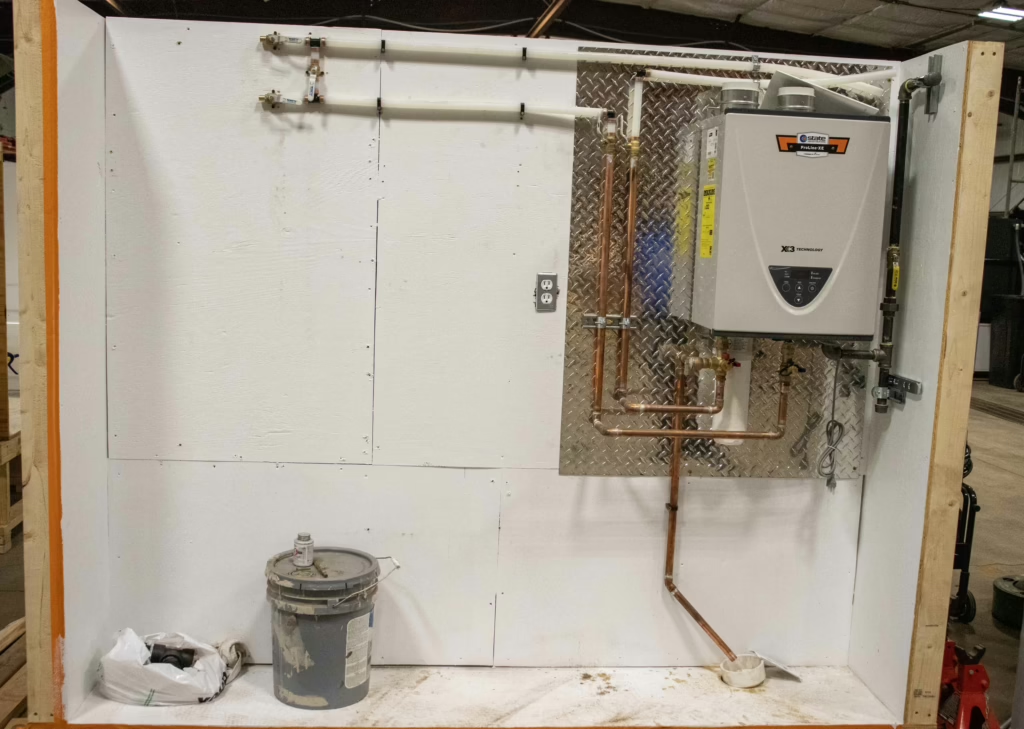
The old heater drained and hauled away, and a new one set, connected, vented and tested, sized to how the household uses hot water at its busiest hour.
A gas tankless unit burns far more fuel while running than a tank does, so we check gas line size and the vent route first. Clive requires any new CSST gas tubing to carry an arc resistant jacket.
Draining sediment and checking the anode rod do the most to stretch a tank's life on mineral heavy water.
When a check valve or pressure reducing valve closes off the supply, heated water has no room to expand. We size and charge the expansion tank and pipe the relief discharge to an approved point.
WHY CLOG BUSTERS
Test the unit, compare the options, install it to code and prove it works.
We check the burner or elements, thermostat, gas valve, anode, relief valve, vent draft and expansion tank charge, then name what failed.
You get the repair and the replacement priced together, and the decision stays with you.
Gas or power and water are shut off, the tank is drained and disconnected, and the old heater leaves with us.
Water lines, gas connection or electrical hookup, vent connector, an expansion tank on a closed system, and relief discharge piped to the 2024 Uniform Plumbing Code. The gas side stays exposed for the inspection Clive Code Section 10-6-11 requires.
We fill and purge the tank, light or power it, confirm the vent drafts, leak check every joint and run hot water at the fixtures before we leave.
FAQ
Still stuck? Call the Des Moines shop at (515) 259-1991.
Yes. Clive Code Section 10-6-8 requires a permit from the Community Development Department before anyone repairs, installs, alters, removes or replaces any part of a fuel gas system, and the gas connection to a water heater is part of that system. Section 10-6-11 says new gas work may not be covered or concealed until it has been inspected and approved.
Repair it when one part has failed on a tank that is otherwise sound, such as a thermocouple, element, thermostat or relief valve. Replace it when the tank body leaks, when rust shows in the hot water and the anode is long gone, or when repairs keep stacking up. We price both options on the same visit.
It can be, if the gas supply and venting can support it. A gas tankless unit draws far more fuel while running than a tank heater, so the gas line often has to be upsized. Clive's fuel gas amendments require new CSST tubing to have an arc resistant jacket and bar CSST from the wall penetration where gas enters the house. We check gas line size, venting and condensate drainage first.
Pressure in the tank climbing past the valve's setting is the usual cause. When a check valve or pressure reducing valve turns the plumbing into a closed system, heated water expands with nowhere to go, and the relief valve bleeds it off. A correctly charged expansion tank absorbs that expansion instead. If pressure is normal and it still drips, the valve is worn. Never plug or cap it.
Size comes from peak demand, not square footage. A tank heater carries a first hour rating, the amount of hot water it can deliver in a busy hour, which should cover back to back showers plus a washer. Tankless units are sized by flow rate and by how much they must raise the temperature of cold winter supply water.
It depends on the energy code. Clive amends the Uniform Plumbing Code so insulation of domestic hot water piping follows the applicable energy conservation code rather than the plumbing code's own section. Insulated hot lines hold heat between draws, so hot water reaches the tap sooner.
It is worth weighing, because mineral scale settles in tanks and coats the heat exchanger in a tankless unit. Clive's plumbing amendments allow a residential softener to be sized under the plumbing code or as specified in the manufacturer's installation instructions. A softener does not replace flushing, and the anode rod still needs checking.
Not by itself. Clive amends the Uniform Plumbing Code so temperature limiting devices for bathtubs and whirlpool tubs are installed at or as close as possible to the point of use. Turning the tank down helps, but the protection that counts sits at the tub valve.
Local coverage