Slow Drains on Every Level
When the upstairs tub, kitchen sink and basement shower all slow down at once, the restriction is in the shared building sewer, not one trap.
Now showing . Phone number, services and service areas are updated to your local crew. Phone, services & service area updated
Find your local crew
Pick a branch and we’ll show the right phone number, services and service area across the whole site. You can change it anytime from the top bar.
Phone, services and service area update to match.
OUR SERVICES
Sewer line cleaning, camera inspection, repair and replacement across Urbandale, from the east side near 66th Street to 142nd Street and Douglas. Open 24 hours.
OVERVIEW
A building sewer is the pipe that carries everything from a building’s drains out to the public sanitary sewer, and the Urbandale Municipal Code defines it as starting two feet outside the foundation wall, where the building drain ends. We at Clog Busters clean, inspect, repair and replace those lines across Urbandale, with crews dispatched around the clock from our Des Moines branch.
According to the City of Urbandale sanitary sewer page, the city’s Engineering and Public Works Department maintains the public sewer on behalf of both the Urbandale Sanitary Sewer District and the Urbandale-Windsor Heights Sanitary Sewer District. The same page says neither the city nor the districts offer sanitary sewer service insurance. Coverage for a failed private line or a basement backup has to come from your own policy.
Urbandale housing comes from two eras, and the sewers fail in different ways. Census Bureau American Community Survey estimates for 2020 to 2024 count about 3,400 of the city’s roughly 18,500 housing units as built before 1970, and about 7,100 built in 2000 or later. Pre-1970 building sewers are often clay or cast iron, where roots work into the joints. Newer PVC lines more often sag where trench backfill settled.
For clogs inside the house, see drain cleaning in Urbandale or hydro jetting in Urbandale. Our Urbandale plumbing page covers everything we do in the city, and our sewer services page explains each repair method.
Sewer work is performed to the 2024 Uniform Plumbing Code, adopted by the State of Iowa effective March 26, 2025, and to the City of Urbandale Plumbing Code in Municipal Code Chapter 155.
SEWER LINE WARNING SIGNS
A building sewer usually warns before it backs up. These signs point past the fixtures to the pipe under the yard.
When the upstairs tub, kitchen sink and basement shower all slow down at once, the restriction is in the shared building sewer, not one trap.
Backups that follow storms often mean groundwater or roof runoff is reaching the sanitary sewer, through a cracked pipe or a connection that should not be there.
Roots chase moisture into clay joints and grow fastest in spring. In a pre-1970 Urbandale home, a stoppage on that schedule is usually roots rather than grease.
Sunken turf along the path from the house toward the street can mean soil is washing into a broken pipe below it.
Air pushed back up through a toilet bowl while the shower runs shows that water cannot get past something further down the line.
PVC resists roots, but a belly where the trench settled holds water and solids until they form a recurring clog.
SEWER LINE SERVICES
Every stage of building sewer work, from a midnight stoppage to a new line to the public main.
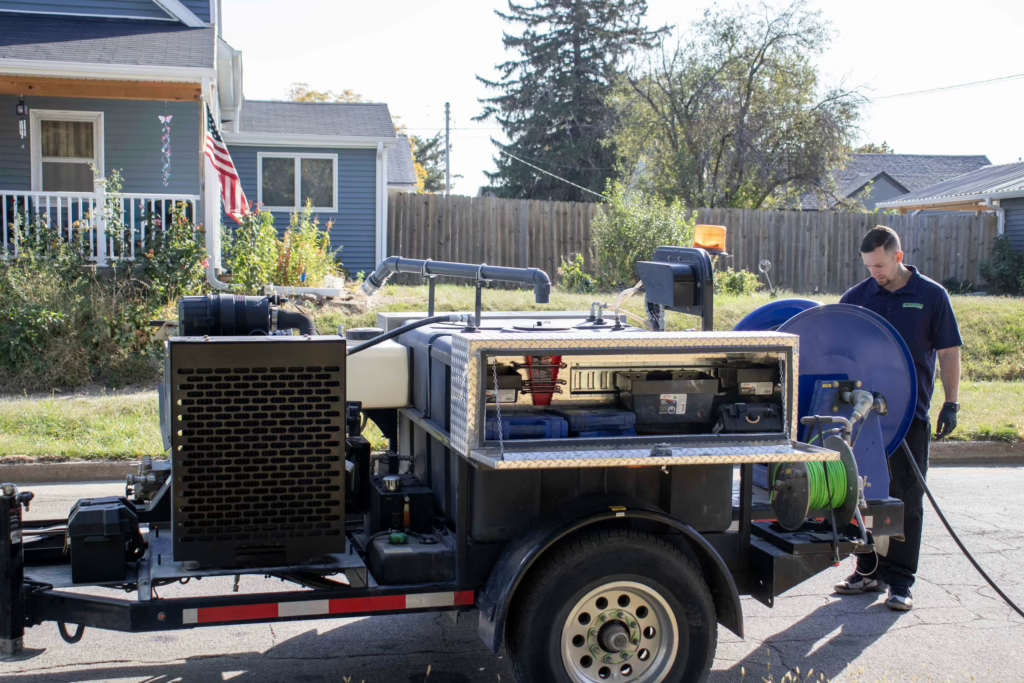
Cabling for roots and hard stoppages, hydro jetting for grease and sludge. On fragile clay we pick the gentler tool, because the wrong one can break pipe that still works.
A recorded run from the cleanout to the public sewer showing pipe material, joints, and any sag, crack or root mass.
Cutting restores flow in a clay line. We show you the joint the roots came through, so you can choose between repairing it and scheduling regular maintenance.
Where one joint or section has failed, we replace that piece in cast iron or PVC of at least SDR 23.5 or Schedule 40, as Urbandale's plumbing amendments call for.
When the camera shows failure along the whole run, we replace it, trenchless where the pipe allows. A trench into the street also needs a city excavation permit.
Urbandale's amendments call for a test tee within five feet of the property line on new building sewer. An accessible cleanout makes every later service quicker and less invasive.
WHY CLOG BUSTERS
Restore flow, record the line, then decide together.
An active backup comes first. We clear the building sewer from the nearest cleanout, so the house has working drains again and the camera has a clear view.
The camera travels the full building sewer to the public main, recording the pipe material, the joints and each defect with its distance from the access point.
We mark each defect at the surface with its depth and note whether it sits under lawn, driveway or street, since street work changes the permits involved.
You get the footage and a plain choice: leave the line alone, cut roots and monitor it, repair one section, or replace the run.
Repairs go under an Urbandale plumbing permit, plus an excavation permit for any street cut. We then run water through the finished line to confirm it drains under full flow.
FAQ
Still stuck? Call the Des Moines shop at (515) 259-1991.
The building sewer serving your home is private plumbing, repaired by a plumber under an Urbandale plumbing permit rather than by the city. City code defines it as the pipe from two feet outside your foundation to the public sewer, which Engineering and Public Works maintains for the two sanitary sewer districts. The city website does not say where the owner's share ends near the street, so we confirm that with Engineering and Public Works before any right-of-way work.
Cost depends mostly on depth, length and what sits on top of the failed section, such as a driveway or mature tree. Street cuts add a city excavation permit and a pavement bond. We camera and locate the fault first, then quote the job before any work starts.
Clearing a stoppage needs no permit under Chapter 155 of the Urbandale Municipal Code, as long as no part of the street right-of-way is dug up. Repairing or replacing a building sewer needs a plumbing permit from the Department of Community Development. Digging in the street or other public property for a sewer connection also needs an excavation permit, which the city issues only after the plumbing permit. Cutting street or sidewalk pavement requires a cash bond or a contractor performance bond.
Storm backups usually mean clean water is getting into the sanitary sewer and overloading it. Urbandale Municipal Code Section 51.02 bars connecting a sump pump, roof downspout, exterior foundation drain or areaway drain to a building sewer that reaches the public sanitary sewer. Where the city has installed storm sump services, it reimburses 100 percent of eligible disconnection costs up to $3,500 for owners who apply before signing a contract. A camera run also shows whether a cracked private line is letting groundwater in.
No. The City of Urbandale states that sanitary sewer service insurance is not offered by the city or by either sanitary sewer district. Protection for a backup or a failed building sewer depends on your own homeowners policy, so ask your agent what it includes.
It is a new sanitary trunk sewer that the Des Moines Metropolitan Wastewater Reclamation Authority is building along Walnut Creek to add capacity for growing communities. Phase 1, called Joint Trunk West, runs from near 142nd Street and Douglas in Urbandale to just east of Campbell Park in Clive. The new pipe runs alongside the existing Joint Trunk and Common Trunk sewers rather than replacing them. It does not change the work needed on your own building sewer.
Often, if the old pipe still holds its shape. Lining cures a new pipe inside the old one, so it suits root-damaged clay joints and cracked cast iron but not a collapsed section or one missing its bottom. The camera footage decides which applies to your line.
Yes, especially for a house built before 1970, when clay and cast iron building sewers were common. Census Bureau estimates for 2020 to 2024 put about 3,400 Urbandale housing units in that age group. A standard home inspection does not camera the sewer, and the video shows pipe material, roots and sags while you can still negotiate.
Local coverage