Slow Drains After Heavy Rain
Drains that lag only after storms suggest clear water is entering through a cracked joint or a banned connection. Pleasant Hill code bars sump pumps, downspouts and foundation drains from the building sewer.
Now showing . Phone number, services and service areas are updated to your local crew. Phone, services & service area updated
Find your local crew
Pick a branch and we’ll show the right phone number, services and service area across the whole site. You can change it anytime from the top bar.
Phone, services and service area update to match.
OUR SERVICES
Building sewer cleaning, camera inspection, locating, repair and replacement for Pleasant Hill homes and businesses, dispatched around the clock from our Vandalia Road shop in Des Moines.
OVERVIEW
In Pleasant Hill, the property owner pays for every foot of the building sewer, the private pipe that carries a building’s wastewater to the public sewer. Chapter 96 of the Pleasant Hill Code of Ordinances puts all costs of installing, connecting and maintaining that pipe on the owner, and Chapter 95 defines where it starts: three feet outside the building wall. We at Clog Busters clean, camera, locate, repair and replace building sewers across Pleasant Hill from our Des Moines branch, which is open 24 hours a day, 7 days a week.
The code also shapes the repair itself: excavation is open trench unless the city approves another method, and nothing is backfilled before inspection. A line found in violation can draw a notice with 30 days to correct it, after which the city may finish the work and assess the cost against the property. So we film and locate the line before quoting, and a trenchless plan goes to the city first.
Related: hydro jetting in Pleasant Hill, our sewer line services and our Pleasant Hill service page.
Building sewer work in Pleasant Hill follows the 2024 Uniform Plumbing Code adopted by the State of Iowa, plus Chapters 95 and 96 of the Pleasant Hill Code of Ordinances.
SEWER LINE WARNING SIGNS
Most of these show up inside the house first, even though the fault usually sits somewhere past the foundation.
Drains that lag only after storms suggest clear water is entering through a cracked joint or a banned connection. Pleasant Hill code bars sump pumps, downspouts and foundation drains from the building sewer.
A washing machine pumps out a fast surge. When that surge meets a restriction downstream, it shoves air back up through the nearest toilet trap.
When basement fixtures drain sluggishly and the second floor seems normal, the restriction often sits in the main line just past the foundation wall.
A depression running from the house toward the street can mean a broken pipe is drawing soil in, or settled backfill has left a low spot.
Sewer gas near a cleanout or along the lateral route usually points to a cracked pipe, a failed joint or a missing cap rather than a simple clog.
Under city code the owner carries every repair cost on the building sewer. A camera run before closing tells a buyer what they are taking on.
SEWER LINE SERVICES
Every service covers the owner's section of the line, from the foundation out to the city sewer.
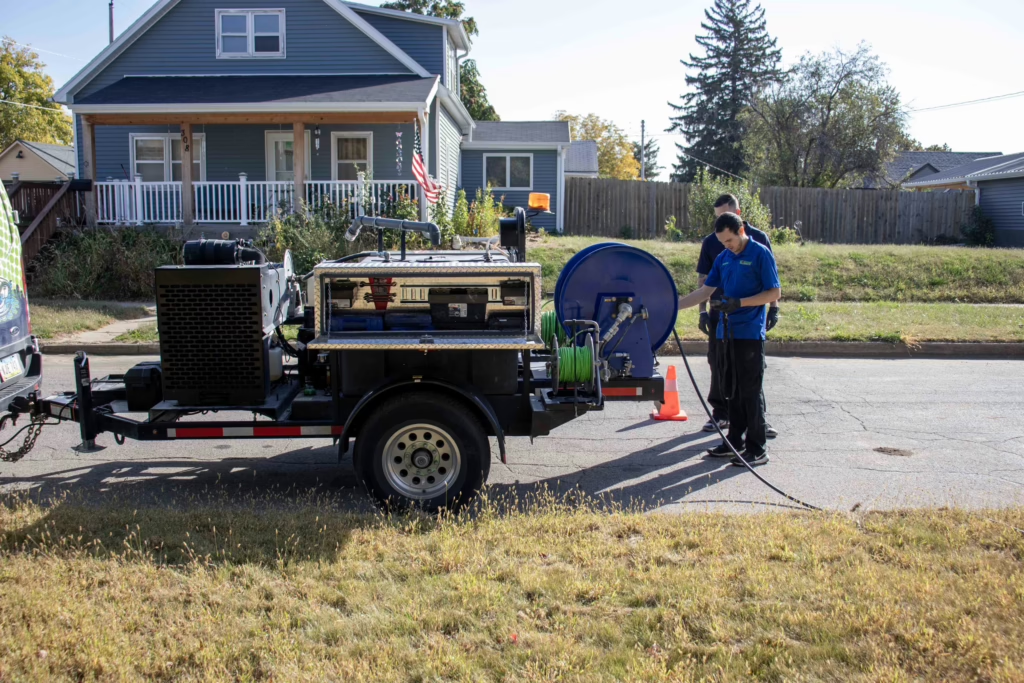
We cable roots and hard stoppages and hydro jet grease and sludge, then a camera pass confirms the bore is open.
The camera travels from the cleanout to the public sewer and records pipe material, joints, sags and breaks, with a measured distance on each defect.
We trace the camera head from the surface and mark the ground over each fault, so any trench stays short and the inspector knows where to look.
One cracked or offset joint gets one section replaced. The trench stays open until the city inspects the work, as Pleasant Hill code requires.
A run failing along its length gets new pipe at least four inches in diameter, laid with enough cover for frost protection. Trenchless options go to the city for approval first.
A cleanout near the foundation gives cleaning and camera equipment a direct way into the building sewer, so future service skips the toilet flange.
WHY CLOG BUSTERS
Flow first, footage second, and the city's rules built into every repair.
An active backup comes first. We open the line through the nearest cleanout so the house can drain and the pipe can be filmed without standing sewage in it.
The camera travels from the cleanout to the public main. Each defect is logged by distance, and you watch the footage with us.
A locator picks up the camera head through the soil. We mark position and depth over each problem so digging is limited to the failed section.
Repair and replacement go through a plumbing permit from the Pleasant Hill Building Department at 5160 Maple Drive, Suite A. Cleaning that alters no pipe is maintenance, and we tell you which applies.
City code keeps the trench open until the work passes inspection. After approval we backfill, run water at volume and confirm the line carries a full load.
FAQ
Still stuck? Call the Des Moines shop at (515) 259-1991.
The owner pays. Chapter 96 of the Pleasant Hill Code of Ordinances assigns all costs of installing, connecting and maintaining the building sewer to the property owner. The city's Public Works Director maintains the public sewer system. We locate each fault so you know whether it sits on your line or the city's.
No. Pleasant Hill code prohibits connecting a sump pump, roof downspout, foundation drain or areaway drain to a building sewer that leads to the public sanitary sewer. Clear water has to go to a storm sewer or another outlet the city approves. Capacity is a live issue: a 2025 city flow analysis found the SE 80th Street sanitary pump station at firm capacity, with an upgrade planned for construction in 2028.
Yes, with the city's approval. Pleasant Hill code requires open trench work for building sewer excavation unless the city approves another method. Lining also needs a host pipe that is still structurally continuous, so it suits cracked or root damaged joints but not a collapsed section. We camera the line first, then take a trenchless proposal to the city when the pipe qualifies.
Repair and replacement need a plumbing permit from the Pleasant Hill Building Department. Any connection to, opening into or alteration of the public sewer also requires a written city permit. Cleaning a line without changing any pipe is maintenance. On permitted jobs, the code bars backfilling until the city has inspected the work.
Storm backups usually mean rainwater or groundwater is entering a line built only for sewage, through cracked joints, broken cleanout caps or connected sump pumps. Pleasant Hill sits on Fourmile Creek, where the U.S. Geological Survey surveyed high water marks from Highway 163 upstream after the July 1, 2018 flood, when the creek's Des Moines gauge hit a record 12,000 cubic feet per second. A camera run shows where water gets into your line.
A new building sewer must be at least four inches in diameter and sized for the building's peak flow. City code calls for enough cover to protect it from frost, and for the pipe to reach the building below the basement floor whenever possible. Where a line must cross a watercourse, the code requires cast iron soil pipe or clay pipe encased in at least six inches of concrete.
The owner gets 30 days from official notice to correct it. Pleasant Hill code applies that rule to building sewer work on private property and in the public right of way alike. If it is not corrected in time, the council can finish the work and assess the cost, collected with property taxes. Our camera footage and repair plan help you act within that window.
Cost depends on what the camera finds. Cleaning is the smallest job, while a repair turns on depth, length, the method the city approves and what sits above the pipe, such as a driveway. We film and locate the line, then give you a price to approve before work begins.
Local coverage